![[SoundStage!]](../sslogo3.gif) Feature Article Feature ArticleInsiders' Forum |
|
| Many times those working within
the audio and video industries have valuable information to share with the consuming
public. However, there are few such outlets for this type of expression. The Insiders'
Forum is intended to allow industry personnel -- manufacturers, designers,
representatives, musicians, etc. -- share information with our readers on a variety of
topics. If you are an industry insider and feel that your have something valuable to
contribute, please contact the editor@soundstage.com. January 1999 Frequency Response and Room Acoustics by Doug Plumb
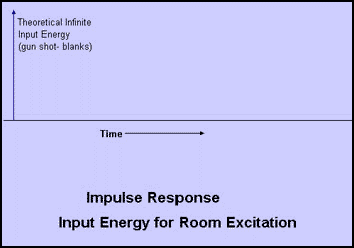
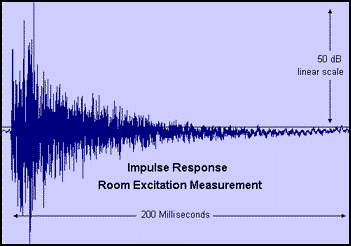
In audio, after all the technical considerations, listening tests, and specifications are considered, frequency response is by far the most important indicator of sound quality. If you don't have a flat frequency response, you have colored sound. It’s that simple. Measurement of frequency response is not a simple matter when in the contexts of loudspeakers and room acoustics. In this article, I will discuss some of the theoretical considerations and how they apply in practice in measuring frequency response for room acoustics. The term "frequency" and how it applies to signals and systems is a manmade concept rather than a naturally occurring phenomenon. Ground work for the concept was submitted by French mathematician Joseph Fourier in 1807. His work, although criticized for its lack of mathematical rigor, lead to a branch of mathematics called Fourier Analysis that is used today in nearly every applied science. The concept of frequency response is used to describe time-domain information in an easily digestible way. Time-domain data often comes in the form of an impulse response. An impulse response, when applied to audio, is the data recorded when a loudspeaker and/or room is excited with a very large amount of energy over a short period of time. Input stimulus to excite the room or loudspeaker is in the form of an impulse response, as shown in Figure 1 below Figure 1: Impulse Response When the room is excited with the impulse response and the result recorded, the room response looks like Figure 2. Figure 2: Room Impulse Response (Time Domain
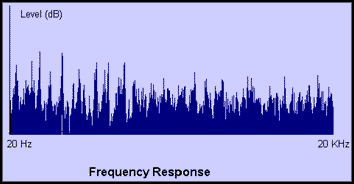
data) This data may be accurate, but it is far too complex to be meaningful. It turns out that if we take this data and perform a mathematical operation called a Fourier Transform with it, the data can take on much more meaning and become less complex. An ideal system would measure to have a flat frequency response across the spectrum. The Fourier Transform would yield results that would show levels constant for all values of frequency. In the time domain, this means that the impulse response would be transferred through a system under test and emerge as an impulse response identical with what went in. This rarely (never) happens in audio. Both room acoustics and loudspeakers introduce "distortions" to this data as it passes through the respective systems (loudspeaker and room). We calculate frequency response to more easily understand measured time-domain data. If we excite a room with an impulse, most of the energy will be reflected around the room before it ever reaches the test microphone. This produces a resulting impulse response that takes a long period of time to completely decay in level. The problem in measuring frequency response is in determining on how much of this data we perform our Fourier transform. If we include all of it, we add the effects of echoes and later reflections. Our hearing has the capability of differentiating between first-arrival sounds and the later reflections. We should measure things the way we hear them and therefore reduce this later reflected energy that interferes with results. For illustration purposes, if we take all of the time-domain data and perform a Fourier Transform on it, the results may look something like this. Figure 3: Frequency response with many room
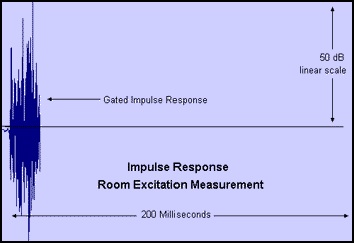
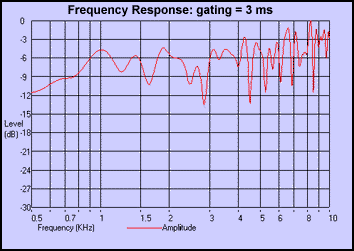
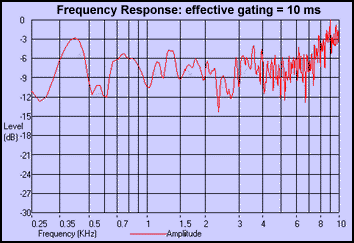
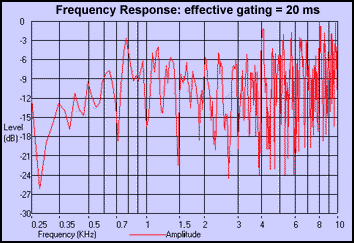
reflections This frequency-response curve is too detailed to provide any insight because it contains the effect of too many reflections. In a measurement like this, the data is often filtered to smooth out the curve and produce a result that indicates overall frequency balance. Changing temperature and air-movement patterns throughout the room would produce another measurement under the otherwise similar conditions that may look quite different. The data needs to be smoothed to be useful and accurate (in terms of evaluating frequency response) in the case of multiple room reflections. After we smooth this data, we are in a sense changing it, and it has lost much of its value in terms of evaluating frequency response. But wait a minute. Our ears can differentiate reflections from direct sound, so why not take the impulse response and eliminate the reflection data and use only the direct sound to do our Fourier Transform calculation ? This is often the approach taken and is termed "gating." These types of measurements are known as "pseudo anechoic measurements" because they mimic what the result would be if the measurement were taken in a test chamber free of reflections. The room impulse response (Figure 2) is shown in Figure 4 after it is gated. Figure 4 If we eliminate all of the time-domain data after a period of 3ms, the frequency-response curve tends to smooth out, but we pay a price in terms of low-frequency measurement limit. The same measurement gated for 3ms shows fewer room reflections interfering with the result and a more easily understood final result. This result is indicative of fewer interfering reflections. See Figure 5 below. Figure 5 The question that immediately comes to mind is, "How much time-domain data should we include in our measurements ?" There is no definitive answer to this question, although there is no shortage of opinions. For many practical situations we do not concern ourselves with the actual answer. Practical considerations often are such that if we had the exact answer we wouldn't be able to make any practical use of it because it would likely involve changing room geometry in an otherwise undesirable or expensive way. We do know that reducing early reflections that occur before 20ms improves both the quality of sound and the stereo imagery. Generally, designers of studio control rooms try to reduce early reflections that occur before 20ms as much as possible. Many practical room geometries dictate that early reflections before 10ms are the only ones that can be effectively dealt with without turning the room into an anechoic chamber (an undesirable effect). We have been discussing frequency-response data and how it is illustrative of time-domain behavior. A good question would be, "Why not look at the actual time-domain impulse response to see if any of these reflections are adequately reduced ?" The answer is quite simple. When we run a room test by sending an impulse response through a loudspeaker, the loudspeaker impulse response gets mixed in with the room impulse response, making reflections hard to recognize. We assume that our loudspeakers have a relatively smooth and flat frequency response, and from this we can conclude that a series of deep dips in frequency is the result of a reflection or set of reflections. Reducing the level of these reflections smoothes out the actual frequency-response curve. The graph shown below illustrates the frequency response of a loudspeaker in a room with very few reflections occurring before 20ms. Figure 6 The graph below shows the effect of many room reflections in this average home listening setup. Figure 7 How do we improve the room acoustics so that this curve gets smoothed out? First of all, geometry of the room must be considered. Is it actually possible to reduce all of the reflections that arrive at the listener before 20ms? A delay of 20ms means that the reflected path must have an effective length that is about 20 feet longer than the direct path. This means that if the reflection is coming from a rear wall, that wall must be 10 feet behind the listener. This isn’t possible in many practical setups. A more practical goal would be to reduce early reflections before 10ms after the original. This can be accomplished by placing absorbing materials on hard surfaces near both the listener and the loudspeakers. Moving the listening position away from a back wall can have a profound effect on imaging and sound quality. This should be a first rule of thumb to apply whenever possible. ...end |
|
| All Contents Copyright © 1998 SoundStage! All Rights Reserved |